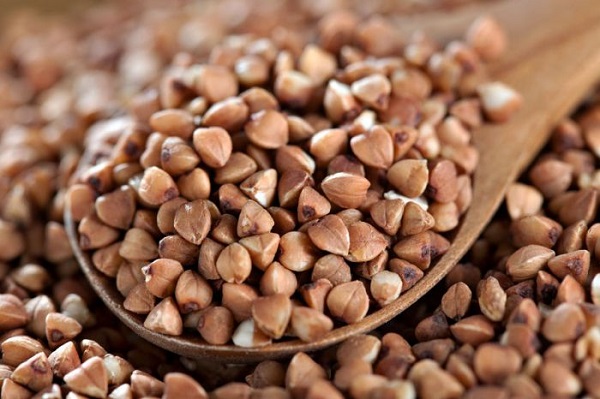
Setting up a recipe for homemade bread, I remembered that I could write you a little about the benefits of various foods, so we will start the journey with buckwheat and buckwheat flour.
Buckwheat (Fagopyrum esculentum and Fagopyrum tataricum) is a plant native to Asia, or more precisely China. The origin of the word “buckwheat” is from the Anglo-Saxon beech and whoet (wheat), because it looks like the fruit of the beech. However, it is interesting that buckwheat is not even a crop of fruit or cereals for which it is considered, but pseudocereals. In pseudocereals, in addition to buckwheat, we have amaranth, qinoa and sorghum. Buckwheat, unlike cereals, does not belong to the family of grass (Poaceae), but comes from the Polygonaceae family.
Buckwheat is a mountainous, one-year-old plant that grows on an area above 1000 m above sea level. Due to the specific chemical composition, buckwheat is a nutritionally high-value raw material, primarily because of the protein rich in essential amino acids, vitamins, dietary fibers and minerals.
Grains of buckwheat are specific triangular structures and it is constructed of an endosperm, a grain shell, and a pericarp (shell).
Peeled buckwheat contains 55% starch, 12% protein, 4% lipids, 2% soluble carbohydrates, 7% of total dietary fiber, 2% ash and 18% of other components (organic acids, polyphenolic compounds, tannins, nucleotides and nucleic acids). As with most natural raw materials and in buckwheat, the content of individual components varies depending on the type of plant.
Of all the ingredients found in buckwheat, the most important is the presence of food fibers (inulin and resistant starch), lignan, β-glucan and phytosterol (sitosterol, campesterol and sigmasterol) for human use.
BUCKWHEAT FLOUR
Buckwheat is most often used in the preparation of food in the form of flour. Buckwheat flour is a high-protein composition. Compared to flour obtained from other cereals, the protein content is lower than the content of the protein of oatmeal, while it is significantly higher in relation to rice, wheat and corn flour, as well as flour of spring and sorghum.
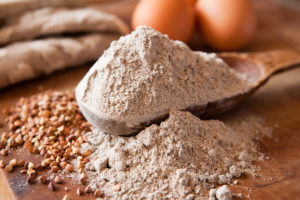
Buckwheat also contains macro and microelements, such as K, Mg, P, Fe, Ca, Cu, Zn, Se, Ba, B, I, Pt and Co. These elements are concentrated in the outer layers of grains and shells, which is important if consumed due to the organism need of the minerals. The commercially white buckwheat flour, which is mainly sold, consists of the central part of the endosperm and is significantly poorer in the content of proteins, vegetable fibers and other nutrients from buckwheat integral flour (obtained by grinding entire grains).
Buckwheat bran is a rich source of total and soluble dietary fiber. A particularly rich source of dietary fibers is the grinding fraction of buckwheat which consists of bran and parts of the shell (40% of the total food fiber, of which 25% is soluble), while the bran without shell parts contains 16% of the total dietary fiber, of which 75% is soluble.
EFFECT OF THE BUCKWHEAT ON HEALTH
Due to the chemical composition (primarily high dietary fiber content, essential amino acids and minerals), consumption of buckwheat affects the reduction of blood sugar, lowering blood pressure and cholesterol.
There are allegations in the literature that the buckwheat protein extract exhibits positive health effects. For example, in 1995, Kayashita and associates found that the extract of buckwheat proteins showed a marked effect in lowering cholesterol.
The results of these authors suggest that the buckwheat protein extract is more potent in lowering the level of cholesterol in the rat serum compared to soy protein isolates. Phytosterols present in buckwheat, although in low concentrations, also show a positive effect in lowering cholesterol levels. In addition, the intake of phytosterol significantly reduces the absorption of cholesterol.
BUCKWHEAT AND ALLERGY
Although there are numerous nutritional benefits of the use of buckwheat and buckwheat products, it is necessary to indicate that the consumption of buckwheat can cause allergic reactions. Symptoms of allergic reactions to buckwheat include asthma, allergic rhinitis and haemorrhage.
Sometimes buckwheat allergy can cause reactions similar to those caused by soy or peanuts. The reaction is instantaneous, mediated by IgE antibodies. As allergenic buckwheat inhibitors we have protease, which exhibits poor binding activity with IgE and molecular weight molecules of 9000, 16000, 24000 and 29000, have been identified as the main allergens of buckwheat grains.
Since buckwheat food is often consumed by celiac diseased people, Weislander and Norback reported in 2001, in the “Allergy” magazine, that cases of allergy to hedge were found in 1% of celiac disease patients.
USE OF BUCKWHEAT
In addition to food production, buckwheat is used for the production of alcoholic beverages, and the liqueur produced from tatar buckwheat is assigned a medical significance. In China, the use of buckwheat is recored in the production of vinegar. In India, buckwheat is cultivated as a vegetable culture, and its leaves are used in the preparation of various dishes.
Common buckwheat, in addition to the purpose of direct food production, is grown in some countries as a source of nectar for the production of honey. Buckwheat flowers, whose number on one plant can be up to 2000, are very rich in nectar, making them attractive for bees. The honey of the buckwheat is dark in color and strong in taste.
Buckwheat finds usage in the production of animal feed, where grinding of buckwheat grains and mixing with cereals can be obtained nutritiously. Shells are sold for the production of special pillows. Tea from buckwheat leaves is used in the treatment of leg edema.